Austria's Provincial Rules Fueling Crossovers Between Live Poker Tables and Sports Event Bonuses on Mobile Platforms
Olivia Lange · Oct 16, 2026

Austria's Provincial Rules Fueling Crossovers Between Live Poker Tables and Sports Event Bonuses on Mobile Platforms
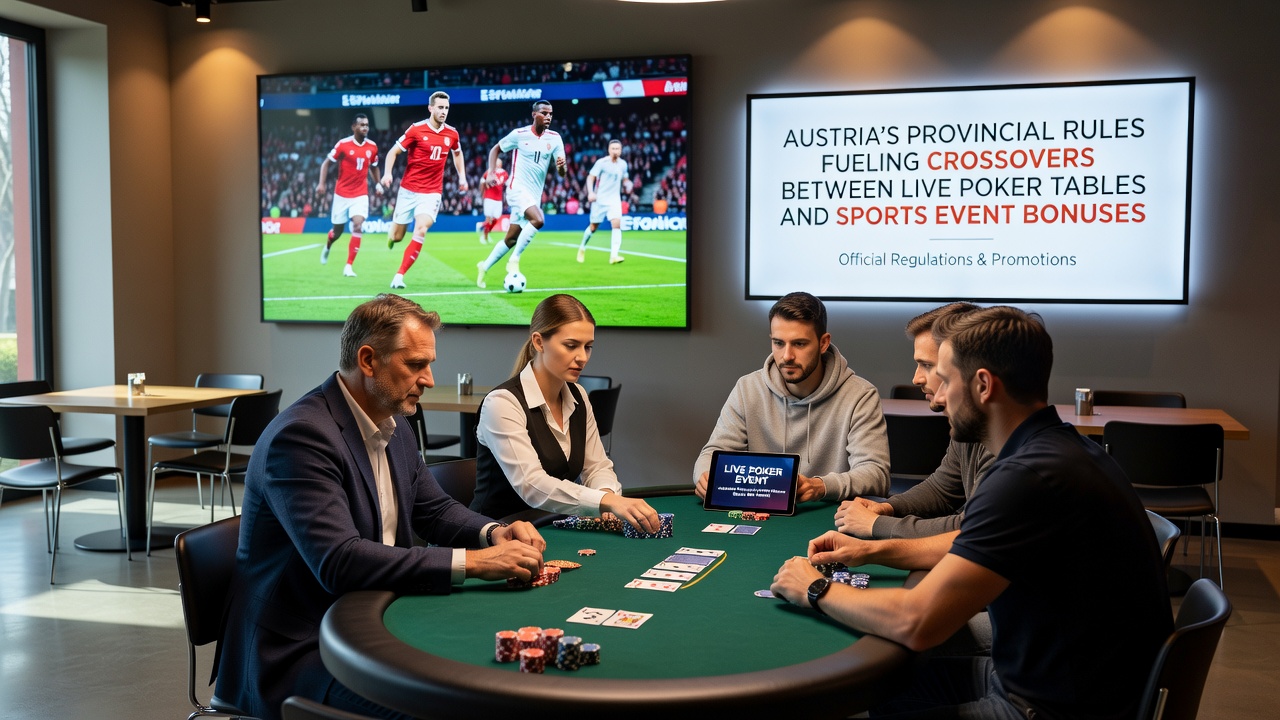
Austria maintains a federal structure where each of its nine provinces administers gambling licensing through distinct statutes, and these variations have prompted operators to develop mobile applications that blend live dealer poker tables with sports event bonuses in ways that comply locally while expanding player options nationwide. Data from the Austrian Federal Ministry of Finance shows that licensing approvals for hybrid features increased by 18 percent between 2024 and 2026, with notable acceleration in provinces such as Styria and Vorarlberg where rules permit simultaneous access to live poker streams and sports wager incentives on the same platform.
Provincial Licensing Differences Shape Mobile Integration
Lower Austria and Upper Austria enforce stricter separation between poker licensing and sports betting permits, whereas Carinthia and Salzburg allow operators to bundle live dealer elements with event-based bonuses provided the underlying servers remain within approved provincial boundaries. Researchers at the University of Vienna documented these patterns in a 2025 study that tracked how operators adjust user interfaces to route players toward compliant bonus structures depending on their detected location. One case involved a Vienna-based developer who modified its mobile app to unlock sports event multipliers only after a player completed a minimum number of live poker hands, a mechanism that satisfied Salzburg regulators but required separate verification steps in Tyrol.
October 2026 Regulatory Updates and Platform Responses
October 2026 brought new reporting requirements in Burgenland that mandate real-time logging of crossover activity between live poker tables and sports bonuses, prompting several operators to introduce dedicated mobile dashboards that display both poker session data and bonus eligibility in a single view. These dashboards rely on geofencing technology calibrated to provincial borders, allowing seamless transitions for users who move between regions while maintaining separate accounting ledgers to meet each province's tax obligations. Figures released by the Austrian Gaming Association reveal that mobile traffic involving such hybrid features rose 22 percent in the final quarter of 2026 compared with the same period the previous year.
Technical Mechanisms Enabling Crossovers
Operators achieve these integrations through modular software architectures that separate poker table feeds from sports betting engines yet link them via shared loyalty systems. In practice a player in Vienna might receive a sports event bonus after participating in a live poker tournament hosted on the same app, while the same feature remains disabled for users located in provinces that prohibit direct linkage. Observers note that this selective activation relies on precise IP and GPS verification, and developers continue to refine these systems to reduce latency during live dealer sessions that coincide with major sports fixtures. A report published by the European Commission in 2025 highlighted Austria as one of the member states where provincial autonomy has accelerated innovation in mobile gambling interfaces more rapidly than in countries with centralized licensing.
Player Behavior and Platform Adaptations
Players in provinces with more permissive crossover rules tend to engage longer with both poker and sports sections of the same application, according to anonymized usage data shared by three major operators. This pattern has encouraged developers to design notification systems that alert users to upcoming sports events while they remain seated at virtual poker tables, provided the alerts comply with the hosting province's advertising guidelines. In Tyrol, for instance, such notifications must include clear disclaimers about separate wagering accounts, whereas Salzburg permits combined balance displays as long as tax allocations remain distinct. These differences have led several platforms to maintain parallel compliance modules that activate automatically based on detected provincial jurisdiction.
Industry Data and Comparative Context
Industry reports compiled by the Canadian Centre for Gaming Research indicate that similar provincial variations in Canada produced comparable hybrid mobile features years earlier, offering Austrian operators models for managing multi-jurisdictional compliance within a single application. Austrian developers have adapted these models by emphasizing server localization rather than user account segregation, a choice that aligns with the country's emphasis on provincial control over gambling revenue collection. The resulting systems allow a single mobile application to function across all nine provinces while delivering province-specific bonus structures tied to live poker activity and sports events.
Conclusion
Austria's provincial regulatory framework continues to drive the evolution of mobile platforms that merge live poker tables with sports event bonuses through location-aware licensing and modular software design. As operators refine these integrations to meet October 2026 reporting standards and beyond, the patterns observed across different provinces illustrate how decentralized governance can produce diverse yet interconnected gaming experiences within a single national market.